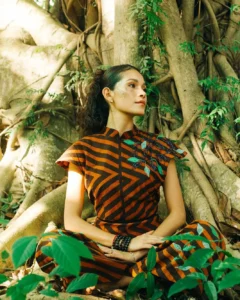
COO AYA Healing Retreats
Plant medicine student
My story begins in Pucallpa, on the red soil of eastern Peru — a mystical land filled with myths, legends, biodiversity, and plants that heal. I had the privilege of growing up in a home shaped by deep respect for nature and by the cultural pride that my parents instilled in me. My father came from the jungle, my mother from the Andes — two worlds that met within me.
From the age of two, I suffered from chronic asthma and various respiratory illnesses that isolated me from the healthy childhood every girl deserves. I spent much of my early life in hospitals, inhaling medicine through nebulizers and receiving treatments so strong they further weakened my body. After years of tests and medical evaluations, pediatricians concluded that I would never fully recover — and that my parents should prepare to face more complex illnesses, since my body could no longer defend itself.
I remember one day, as I cried in pain and my lungs began to close, a doctor approached and said softly:
“If you have faith, only a miracle can heal you. Ask God.”
Those words etched themselves into my heart. As a child, my faith was boundless. Each night, I prayed to God and dreamed of the day I would be freed from all suffering.
One of my greatest blessings was to have both of my grandmothers — women of faith, courage, and deep connection with the healing power of plants. Each in her own way opened paths of healing and hope for me.
My paternal grandmother, Olguita, belonged to the Kukama people. Though she had no formal education, her devotion to the forest was profound. Through long dietas, dreams, and visions, she learned to work with the spirits of the plants. She used this knowledge to heal her children and the neighboring communities with barks, roots, and leaves.
My maternal grandmother, Norita, grew up in the Andean region of Ayacucho. As a woman, she was denied many rights and endured painful experiences from an early age. Yet she taught herself and began creating her own herbal formulas to treat respiratory problems and other illnesses in her village of Ocros.
Both of my grandmothers, with their empirical plant knowledge, came together to prepare the remedies I drank morning, afternoon, and night. Many of these treatments were bitter and difficult to swallow — strong in taste and smell — yet they became part of my daily ritual.
I remember beginning my dietas with plants around the age of three. By five, I had clearer memories of the prayers and intentions I held before bathing with the herbal mixtures and drinking the thick green liquids made from ñucñu pichana and matico, or applying ointments of black boa or lizard fat. These rituals were always accompanied by the encouragement of my grandmothers, who would tell me:
“You are strong. You must face your fears. Don’t be afraid of the animals that appear in your dreams — they are good. Have faith in God, for nothing is impossible for Him and His creation.”
Those morning rituals, and the complex dreams that followed, became sacred experiences. At night, I would dream of the spirits or mothers of the plants I had ingested — sometimes seeing black boas or lizards, manifestations of the animal spirits whose fats were used in protective rituals to bring warmth to my cold body.
When I turned seven, my birthday wish was simple: to heal completely.
One morning, after an intense purga, I expelled from my lungs all the phlegm that had accumulated over years of illness. I can still recall the astonishment on my family’s faces as they realized that what had caused me so much suffering was finally gone. Days later, medical tests confirmed what we already felt — my lungs were completely clear.
That day, my family and I celebrated not just my healing, but the faith, discipline, and love that had made it possible — the dietas, prayers, food restrictions, and plant baths, all of it guided by patience and devotion.
I share this personal experience because I believe it is essential to honor, preserve, and protect the ancestral science of Indigenous peoples and to recognize the traditional masters without whom this sacred medicine would not exist. Their knowledge offers humanity not only ways to heal the body, mind, and spirit, but also paths to heal entire communities and societies.
However, with the growing global recognition of ayahuasca and other Amazonian plant medicines, deeper questions arise within medical, psychological, and social fields:
This essay seeks to explore these questions with an ethical and human lens — weaving together my own lived experience in the Amazon with academic and scientific perspectives that help us reflect more deeply on the meaning of this medicine.
In Amazonian communities, the knowledge of ayahuasca and other master plants is the result of centuries of observation, experimentation, and oral transmission — a living science that continues to evolve through experience.
Since the arrival of Franciscan missionaries and Christianity in these regions, the use of medicinal plants like ayahuasca has often been distorted or condemned. Even some local people in the Peruvian jungle came to believe these practices were witchcraft or “black magic,” seen as sinful and condemned by religion.
Yet today, many scientists, anthropologists, and researchers recognize this body of knowledge as an ancestral science — a profound understanding of the spiritual and energetic world of the plant kingdom that has inspired humanity for millennia. It is a knowledge grounded in experience and in a sacred relationship with nature — what could be described as an animist worldview, where all beings are alive and interconnected.
The epistemologies of Indigenous peoples see ayahuasca as part of a complex medical system that unites spirituality with community life. As Biaggi (2025) notes, for the Shipibo-Konibo people, “ayahuasca is not an end in itself but a tool within a complete medical system.”
Connecting with these plants requires careful ritual preparation. The dietas (samas), a clear healing intention, the guidance of a spiritual maestro, and post-dieta integration practices form an inseparable whole.
The dieta, in particular, is considered the foundation of healing: it involves dietary and sexual restrictions, periods of isolation, ritual cleansing baths, and the ingestion of specific plants over extended periods — all of which prepare body and soul for the encounter with the medicine.
In Peru, this ancestral science has received formal recognition. In 2008, the Peruvian government declared “the traditional knowledge and use of ayahuasca practiced by Amazonian Indigenous communities” as Cultural Heritage of the Nation, emphasizing the importance of its protection, appreciation, and respect.
An inspiring case of intercultural research took place in Mexico during the 1980s, when neuropsychologist Jacobo Grinberg sought to bridge Western science and shamanic understanding of consciousness. His “Sintergic Theory” proposed that a universal energy field co-created by the brain could explain phenomena observed in his studies with the healer Pachita, who performed rudimentary surgeries using only a kitchen knife and demonstrated an extraordinary mastery over matter and energy.
Though controversial, Grinberg’s work was a courageous attempt to give scientific validity to phenomena long described by shamans — without discrediting Indigenous voices. This marked a shift in perspective: no longer viewing ancestral wisdom and science as opposites, but as two complementary ways of understanding the same mystery.
Recognizing Indigenous science as legitimate means acknowledging that, even if its methods differ from Western standards, it produces tangible and verifiable results — healing, harmony, and profound connection with nature.
The traditional ayahuasca masters are, in essence, ancestral scientists: devoted to the study of mind, spirit, botany, and the sacred — carriers of a science that deserves an honored place beside modern knowledge.
Today, ayahuasca and plant-dieta retreats have captured growing interest in urban and Western contexts, giving rise to a crucial question:
Do Indigenous communities receive the recognition and fair benefit they deserve for sharing their medicine?
Reciprocity means returning something of value in exchange for what is received. For the Indigenous peoples who have carried these traditions for generations, this reciprocity can take many forms — from fair financial compensation to long-term support for the preservation of their cultures, languages, and lands.
These communities often face harsh realities: the loss of natural resources, environmental degradation, exploitation by external agents, forced displacement, and even threats to their lives. In this context, to use ayahuasca without reciprocity is to fall back into the same colonial dynamics of extraction that have historically harmed Indigenous peoples.
The historical debt toward these communities is immense. Yet there are encouraging steps forward. For example, the declaration of ayahuasca and traditional medicines as national cultural heritage in Peru marks an important acknowledgment of their value. But true reciprocity requires more than recognition on paper; it requires clear and just commitments from retreat centers operating on Amazonian land, from researchers studying these medicines, and from all who benefit from this ancestral knowledge.
Reciprocity calls us to ask difficult questions:
Without reciprocity, even well-intentioned projects risk reproducing imbalance. With it, however, a bridge of healing and mutual empowerment can be built between worlds.
Reciprocity is not charity. It is an ethical exchange of energy — a conscious act of balance between receiving and giving. It means respecting Indigenous protocols, paying fair wages to maestros and local staff, protecting sacred territories, supporting educational initiatives, and ensuring that benefits flow back to the communities who sustain the medicine’s lineage.
As I reflect on my own story — my healing guided by the faith and wisdom of my grandmothers — I understand that reciprocity is not only about economics or recognition. It is a spiritual principle: to give thanks in action, not only in words.
It is a way of keeping the circle of healing alive.
The globalization of ayahuasca has also brought a complex phenomenon: the exotification of Amazonian rituals and traditions.
Exotification occurs when cultural elements are romanticized, simplified, or commercialized for external consumption, stripped of their true meaning. Some Western facilitators — and even some mestizo or local practitioners — have adapted the ceremony to attract tourists, transforming sacred rituals into experiences of spectacle.
In these scenarios, the deep healing intent of the work can be replaced by a focus on dramatic visions, music, and aesthetics meant to impress outsiders rather than to restore harmony to the soul.
This trend has also created stereotypes — portraying Indigenous peoples as mystical guardians or keepers of magical secrets, while ignoring their contemporary struggles, diversity, and human complexity. Sacred practices are often trivialized: traditional clothing becomes costume, ícaros are sung without lineage or understanding of their origin, and the spiritual dimension is reduced to performance.
To stop this distortion, intercultural education is essential.
Participants from outside the Amazon must learn the history, function, and spirituality behind each plant, chant, and ritual. Facilitators who are not Indigenous must recognize their limits, seek guidance from experienced maestros, and honor the cultural roots of what they practice.
Only through genuine respect and deep understanding can the Amazonian tradition be honored without turning it into a product.
Ayahuasca is not an entertainment or a novelty. It is a sacred medicine that works within a web of prayer, discipline, and cosmological meaning. Those who approach it should do so with humility — not as consumers of visions, but as students of a lineage far older and wiser than ourselves.
Ethics is the foundation that builds trust, cooperation, and respect.
It determines how we relate to Indigenous communities: recognizing their wisdom and compensating them justly.
Ethical reciprocity is not only about credit or acknowledgment — it must be accompanied by concrete, meaningful actions:
In the facilitation of ceremonies, ethics also means protecting participants, ensuring safety and emotional containment, and refraining from any behavior that exploits vulnerability.
A truly ethical relationship with the Amazon begins with listening — listening to the people, to the forest, to the medicine itself. It requires humility to learn from those who have walked this path long before us, and courage to act in ways that protect them.
When ethics, reciprocity, and recognition come together, healing becomes collective. Ayahuasca can then fulfill its higher purpose — not just as a tool for individual transformation, but as a medicine to restore harmony between cultures, peoples, and the Earth itself.
This reflection invites us to reconsider the importance of traditional masters and ancestral wisdom in the use of ayahuasca, as well as the ethical and cultural dimensions that emerge in its meeting with the modern world.
Ayahuasca medicine invites us to build bridges between diverse fields of knowledge — from Indigenous science to modern medicine, from spirituality to technology — but such bridges must rest upon the pillars of respect, reciprocity, and humility.
Indigenous science deserves full recognition and value. Its effectiveness has already been proven across generations and contexts. To revalue this knowledge is to contribute to the healing of the historical wounds left by colonialism and cultural erasure.
Reciprocity reminds us that those who benefit from this science must also give back — by protecting and empowering Indigenous cultures through fair pay, education, and advocacy.
Exotification, on the other hand, remains a real risk when ayahuasca is used merely as a tourist attraction or a cultural show. Overcoming it requires education, Indigenous leadership, and a return to the spiritual essence of ceremony.
From my own journey, I close this reflection with deep gratitude for my grandmothers — my first teachers in natural medicine and in the sacred connection between humans and plants. Through their care, I learned that true wisdom is humble, and that generosity is the highest form of strength.
We hold a shared responsibility: to build a just future for traditional medicines, Indigenous science, and the peoples who carry them — honoring the past, acting with integrity in the present, and dreaming a future where ayahuasca heals not only bodies, but the bonds between cultures.
Biaggi, G. (2025). Integración terapéutica post-Ayahuasca [Diapositivas de conferencia]. Sociedad Peruana de Medicina Enteógena e Intercultural (SPMEI). [11]
Hernández Gómez, V. I. (2022). La Teoría Sintérgica de Jacobo Grinberg Zylberbaum: experiencia, consciencia y unidad. Reflexiones Marginales, (67).
Ministerio de Cultura del Perú. (2008). Resolución Directoral Nacional #836/INC – Declaran Patrimonio Cultural de la Nación a los conocimientos y usos tradicionales del Ayahuasca practicados por comunidades nativas amazónicas. Lima: INC.
Shipibo-Konibo: Rol del médico tradicional. (2024). Curso SPMEI – Ética, Seguridad y Salud en Medicina Tradicional. [Apuntes de seminario].