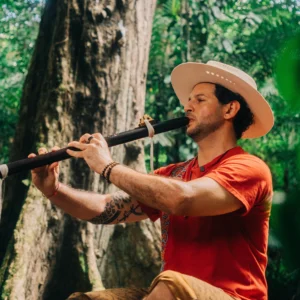
Elio Geusa

Elio Geusa

Founder

A grounded guide for seekers who value safety, integrity, and long-term healing

Ayahuasca has gained international recognition as a potent plant remedy from the Amazon that promotes healing, enlightenment, and spiritual development. Indigenous lineages like the Shipibo-Conibo people have long maintained and safeguarded this culture in Peru, especially in the Amazon region.

The number of retreats providing ayahuasca experiences has increased along with interest. While many are based on honesty and compassion, others put business, volume, or visibility ahead of respect and safety. The subject of how to pick a safe and moral ayahuasca retreat in Peru becomes crucial for anyone thinking about taking their first or even tenth retreat.

How do you choose a safe and ethical ayahuasca retreat in Peru?

This guide is written to help you make that decision with clarity, humility, and discernment.

Ayahuasca Is Not a Product — It Is a Relationship

Before looking at logistics, it’s important to understand one core truth:

Ayahuasca is not a commodity!
It is part of a living Indigenous tradition, passed down through generations.

In traditional Amazonian cultures, ayahuasca is not taken casually or recreationally. It is held within a ceremonial, cultural, and ethical framework that includes:

  • Years of apprenticeship
  • Dietary restrictions
  • Community accountability
  • Spiritual discipline
  • Ongoing integration into daily life

Any retreat that presents ayahuasca as a quick fix, a psychedelic thrill, or a guaranteed transformation is already moving away from its roots.

1. Indigenous Lineage and Authorization Matter

A safe and ethical ayahuasca retreat will be transparent about who holds the medicine.
What to look for:

  • Clear mention of Indigenous lineage (e.g., Shipibo-Conibo)
  • Named maestros or maestras with life-long training
  • Long-term relationships between the retreat center and the Indigenous community
  • Respectful language around the tradition (not exoticizing or romanticizing)

Red flags

  • “Shamans” rotated weekly
  • No mention of lineage or training
  • Vague bios with no cultural context
  • Retreat owners positioning themselves as the main healers

Lineage brings accountability. Without it, there is no container holding the work together.

2. Medical and Psychological Screening Is Non-Negotiable

Ayahuasca is powerful. It interacts with the nervous system, emotional memory, and neurochemistry.

A responsible retreat will require thorough screening before accepting participants.

Ethical screening includes:

  • A detailed medical intake form
  • Medication review (especially antidepressants, SSRIs, MAOIs)
  • Mental health history (psychosis, bipolar disorder, severe dissociation)
  • Opportunity for follow-up questions or interviews

If a retreat:

  • Accepts everyone immediately
  • Says “ayahuasca knows best”
  • Minimizes medical risks

That is not spirituality — it is negligence.

Ethical retreats understand that sometimes the safest answer is not now.

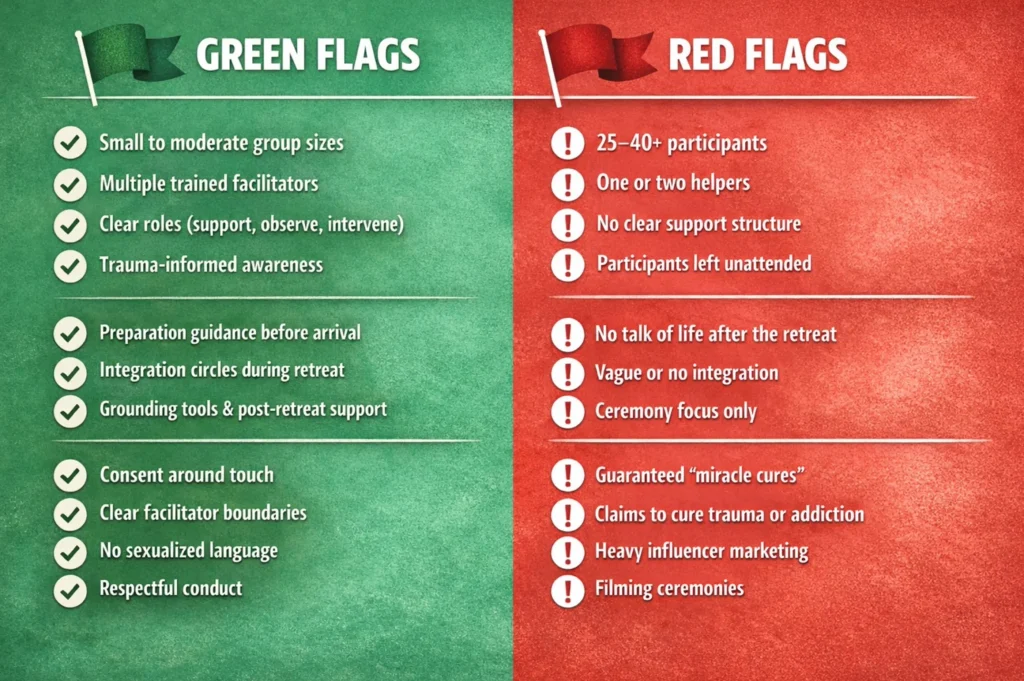
Green and red flags

3. Group Size and Facilitation Support

Ayahuasca ceremonies require presence, attention, and care.

Safer retreats tend to have:

  • Small to moderate group sizes
  • Multiple trained facilitators present
  • Clear roles (who supports, who observes, who intervenes)
  • Trauma-informed awareness

High-risk setups include:

  • 25–40+ participants
  • One or two helpers total
  • No clear support structure
  • Participants left unattended during intense experiences

Large groups with minimal support increase the likelihood of panic, dissociation, or retraumatization.

Healing is not scalable without losing quality.

4. Integration Is as Important as the Ceremony

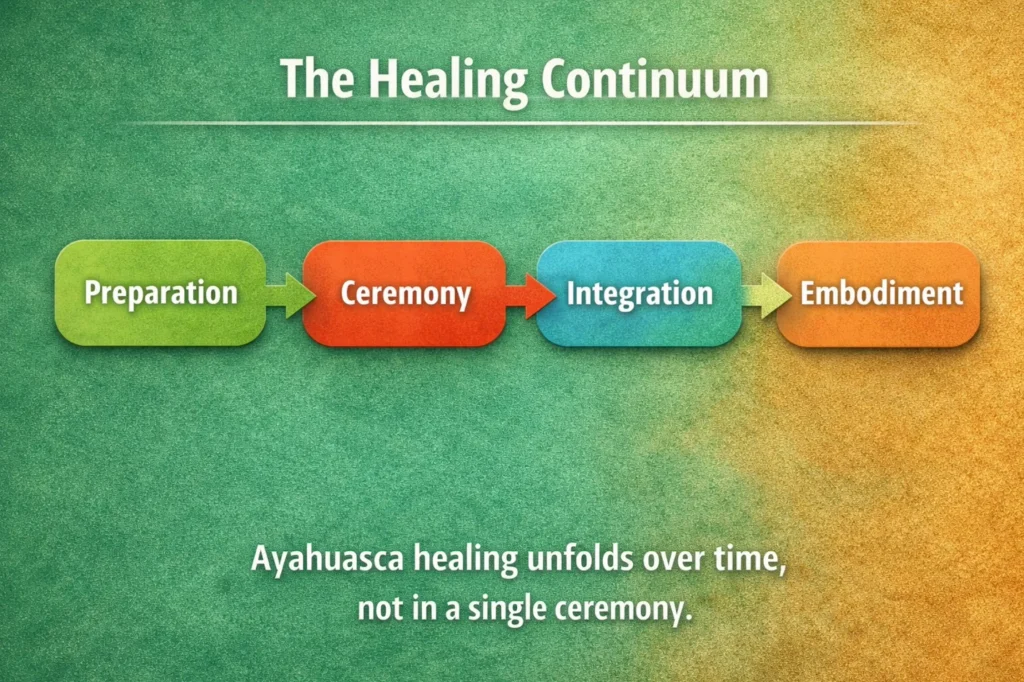
One of the most overlooked aspects of ayahuasca retreats is integration.

Ayahuasca does not “do the work for you.”
It opens doors — what you do afterward determines whether healing takes root.

Ethical retreats provide:

  • Preparation guidance before arrival
  • Integration circles during the retreat
  • Tools for grounding and nervous-system regulation
  • Post-retreat support or resources

Be cautious if:

  • There is no discussion of life after the retreat
  • Integration is mentioned vaguely or not at all
  • The focus is only on ceremonies, not embodiment

Without integration, insights can become destabilizing rather than healing.

healing continiuum

5. Beware of Hype, Guarantees, and Spiritual Marketing

Ethical healing spaces are humble.

Red flags include:

  • Promises of guaranteed healing
  • Claims to cure trauma, depression, or addiction
  • Heavy influencer marketing
  • Filming or photographing ceremonies
  • Pressure to “surrender” without consent

Ayahuasca is unpredictable by nature. Anyone who guarantees outcomes is prioritizing marketing over truth.

Sacred spaces are not content studios.

6. Clear Boundaries and Consent

A safe retreat has clear boundaries — emotional, physical, and energetic.

This includes:

  • Consent around touch and support
  • Clear facilitator roles
  • No sexualized language or behavior
  • No power dynamics disguised as “spiritual teaching”

Any retreat that blurs boundaries or encourages dependency should be avoided immediately.

7. Transparency About Money and Reciprocity

Ethical retreats are open about:

  • Who owns the center
  • How Indigenous communities are supported
  • Where money goes
  • What participants are paying for

Transparency is a sign of integrity.

If these questions are met with defensiveness or vagueness, that is a warning sign.

8. Location Alone Does Not Equal Authenticity

Peru’s Amazon is vast. Simply being “in the jungle” does not guarantee safety or ethics.

What matters more than location:

  • Relationships
  • Practices
  • Accountability
  • Values

A retreat close to Iquitos or Pucallpa can be deeply ethical or deeply problematic. The difference lies in how the work is held.

Choosing with Discernment, Not Fear

Choosing an ayahuasca retreat is not about finding the most famous or most Instagrammable place.

It is about finding a space that:

  • Respects the medicine
  • Protects your nervous system
  • Honors Indigenous wisdom
  • Supports your life after the retreat

Take your time. Ask questions. Listen to your body.

A Note on Ethical Practice

At AYA Healing Retreats, our retreats are guided by:

  • Shipibo lineage
  • Careful screening
  • Trauma-informed facilitation
  • Deep integration support
  • Long-term reciprocity with Indigenous communities

We believe ayahuasca is not about chasing peak experiences, but about cultivating long-term healing, humility, and embodiment.

Final Reflection

Ayahuasca is not a shortcut.
It is a relationship! And one that asks for patience, respect, and responsibility.

The safest and most ethical retreat is the one that meets you where you are, without promises, without pressure, and without spectacle.

Choose wisely.
Your healing deserves care.

Which Master Plant are you? Take the quiz to know!